Saturday, 26 November 2016

The Doctor Is In - I'm Not

Although those of us who love history often think fondly of the past, when I come across artifacts like this wooden doctor's box I am reminded of how happy I am to live in the 21st century!  This box is part of our collection and the tools inside would have been used on human beings in the days before general anaesthesia and antibiotics.  These boxes contained surgical instruments that doctors used when amputations were necessary.


The box has a hinged lid and two shelves inside.  On the bottom is a green rough cloth, most of which is worn off.  Inside it is lined with deep red velvet and has indentations for the equipment it carries.


The first shelf contains clippers, a puller, a tenaculum, and a knife.  The clippers are made of metal and have sharp cutting edges.  The puller is metal as well with vise shaped teeth.  Both have two handles in order to get a good tight grip.


The knife shown below is metal with a rubber handle.  The rubber is not smooth so that even if the surgeon's hands were sweaty or covered in blood, he would not lose his grip.  This knife was used to cut through flesh and muscle, down to the bone. 


The bottom shelf has two saws and a spiral tourniquet.  The cloth was wound around the limb and the spiral was turned to tighten it as much as possible in order to stop the bleeding.  Once the knife had done its work, the surgeon would then use the large saw to cut through the bone and finish amputating the limb.  The smaller saw was used for smaller bones.

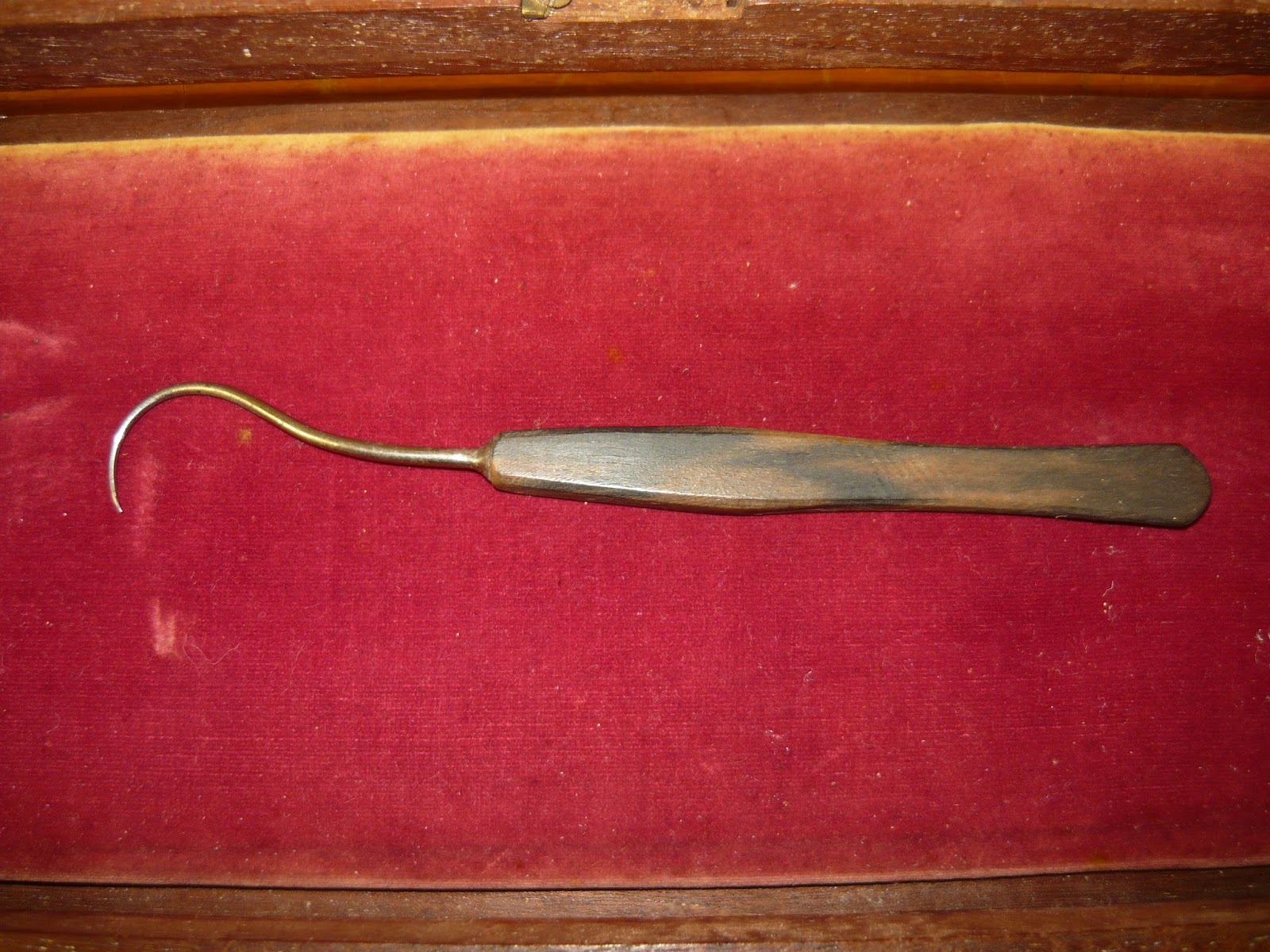
The tenaculum shown below is made of wood and metal and was used to pull 
arteries out of the stump once a limb had been amputated so they could be tied off and stop bleeding.

So, next time you see volunteers fund raising for hospitals, remember this equipment.  Thank goodness amputations are not as common today, but if they are necessary, these tools stay in the museums and out of the operating rooms.  


Sunday, 20 November 2016

No Stuffing Allowed

Nowadays when we vote, we use a paper ballot that gets put into a cardboard box.  Well, in Canada anyway - the U.S. is an entirely different story!  But back in the day, ballot boxes were made of wood with the name of the polling area engraved into them.

You can see the box in this picture has "Westfield" engraved into it with gold lettering.

It was sealed with wax in order to secure it and minimize the risk of having the ballot box "stuffed" with fake votes.  You can still see some of the red wax that was used to seal this box.


The box has a brass handle on top and a hinged lid.  When you open it, you can still smell the wood.  You know that feeling you get when you open a new book and smell that wonderful, new book smell?  It's a very similar feeling.


The good thing about using wooden boxes is that they weren't discarded and could be used over and over again - very environmentally friendly.  The not-so-good side was that they had to be stored somewhere safety so they wouldn't suffer damage like rot and mold.  Imagine how much space a ballot box for each polling area would take up!  Each box also had a key to lock it, which you can see if you look closely at the bottom of this one.  This ballot box was found in the attic of the Kings Co. Courthouse and was donated to the museum in 1966.  It's currently used as our admissions donation box.


And, if you come to the museum and want to smell the ballot box, just ask.  I totally understand. 


Saturday, 12 November 2016

Not Your Local Beauty Cream!

Can you imagine having a job where you are given anti-gas ointment as part of your standard equipment?  That’s exactly what soldiers in World War 2 had!  Although gas masks were the number one defence against a gas attack, particularly mustard gas, more was needed. 


The yellow tin of Anti-Gas Ointment No. 2 is small and easily fits into a pocket.  It’s hinged on one side and contained 8 tubes of cream.  This particular tin has 7 tubes.  Whether they were unused because they weren’t needed, or unused because the person who had them was not able to use them, we do not know.


The instructions on the tin are very clear; the front of the tin tells you what it’s for and the back has clear instructions on how to get the cream out of the tubes.   The tubes themselves have directions as well - probably good because if you're in a panicked rush, you probably aren't reading the tin!


If you were gassed, you had to wipe off the residue as quickly as possible then get the cream on your body right away.  Being exposed to mustard gas was expected, and this cream has a strong alkaline content which helps neutralize the gas residue that would end up on someone’s skin.  Rubbing the cream on your skin would not prevent gas burns, but would lessen them.


As the wars went on, the military discovered it needed different sorts of creams for different environments.  The yellow tin, No. 2 ointment featured in this picture was used mainly in environments that were cool and dry.   Blue tins were anti-gas ointment No. 5, and green tins were anti-gas ointment No. 6.  No. 6 was mainly used in hot, humid environments like Southeast Asia.  


Saturday, 5 November 2016

Night Vision

They just look like an old pair of binoculars but they are really "Binoculars for Night Use" issued by the RCAF to soldiers fighting in World War 2.  You can see the "RCAF" engraved into them in the photo below. They are a little over 4" high and about 4" long so easily fit into one hand.  You can see from the picture that the bigger lenses at the end are quote a bit larger than the ones you look through!

Made of brass with a black coating you can see the wear on them where they would have been held. They are difficult to adjust and fairly heavy.  There's a small wheel on the top that you can move but it's not easy.  I can't imagine being a tailgunner, flying at night in a plane trying to adjust these quickly while looking for enemy aircraft.

They fit into a nice, hard leather case lined in blue velvet.  The case has leather loops on the sides as well as brass buttons that can attach to straps.  On the top written in white letters is SF6625.  If anyone knows the significance of this number we'd love to hear from you in the comments below! 


The Royal Canadian Air Force was renamed in 1924, prior to that it was simply called the Canadian Air Force.  Night vision goggles have come a long way since World War 2.


Sunday, 30 October 2016

Dead Man's Penny


It’s called the Dead Man’s Penny.  It’s a small bronze plaque that was personalized with the name of any fallen soldier in the service of the British Empire during World War 1.  The pennies are made of bronze and measure about 12cm in diameter – you can see how large it is in the palm of my hand.  It’s quite heavy, probably weighing about 1lb. 
 
 
The penny was sent to their next-of-kin in a package that included a cardboard envelope with a parchment scroll and letter from King George V. 


We have two in our museum, given in recognition of service by Lionel Wellington Nutter and Percy Leonard Robertson, both local Kings Co. men who died in World War 1.  The inscribed lettering is raised and the names are in a rectangular box.


“He died for freedom and honour” is inscribed in raised lettering as well. The front of the penny also features a raised image of Britannia, a lion, and 2 dolphins. Britannia is holding a laurel wreath and a trident.  The dolphins symbolized Britain’s sea power.  The back is blank; no images or inscriptions.
If you look closely at the bottom, you can see a smaller lion underneath the bigger one and it’s attacking the German eagle.  
 
We have some information on Lionel, but not as much on Percy.  Lionel Wellington Nutter of Kars was born on April 30th, 1895. In March of 1915 Lionel enlisted and served with the 5th Canadian Mounted Rifles. The 5th Battalion Canadian Mounted Rifles was formed in 1915 in Quebec. Later in 1915 the Battalion went overseas where they became a part of the 3rd Canadian Division, 8th Canadian Infantry Brigade. Between 1916 and 1918 the Battalion fought in France and Flanders. On March 25th, 1916, after just one year of being part of the Mounted Rifles, Lionel Nutter was killed. 
No rank was included in the penny’s inscription because, regardless of rank, the sacrifice was the same.  Over 1.3 million of them were sent out.
For more information, check out this link:  http://www.greatwar.co.uk/memorials/memorial-plaque.htm


Saturday, 22 October 2016

No Bells in My Belfry

The biggest thing I remember about starting university was that there was no bell! In modern schools today there are automatically timed, sophisticated bell systems. However, in bygone days some schools had a belfry where the teacher could ring a bell to signal the start of school.  Many of the old one room school houses - small buildings with no belfry - had a handheld bell that the teacher rang to let their students know it was time to come in for the start of lessons, or come back in after lunch.

This particular bell is made of polished brass with a wooden handle.  It stands about 12" high and is quite heavy.  


It is also very loud!  You can see the clanger in this bell is a good size and is made from the same polished brass as the bell.


This bell is not only functional but is also very beautiful.  You can see from the top that it has a polished brass top above the wooden handle.  


My mother started her teaching career in one room school houses and I remember her talking about using these bells.  Maybe they could be used in classrooms today to get the attention of talkative students!

Wednesday, 12 October 2016

There's No Technology Like Old Technology

Ahhhhh, books.  I love books.  I know new e-readers are all the rage, they take up less room and you can easily travel with a ton of books loaded into your new tech and it doesn't take up much space.  But...there is nothing like the feel of a book.  The thrill of being the first to open a brand new book, the smell, the feel of the pages.  And of course there's the thrill of reading an old book and wondering how many other people have turned its pages.  It gives you a kind of connection to people you don't even know because of the shared experience of handling those pages, reading those words, and sharing that story.

So, I can't begin to tell you how exciting it was to have a book donated to our collection that was printed around 1729!

The name of the book is Human Nature In Its Fourfold State written by Thomas Boston, a Scottish church leader who lived from 1676 - 1732.  The book is a religious classic from Scotland and is still available in print today - just google it.


This particular book was well used by the looks of its condition.  You can see from the picture that at some point it was covered with a lighter coloured, heavy paper.


In this picture you can see how someone tried to stitch the spine back together with string.    
Here you can see on the bottom left-hand page that the preface was written by Robert Wightman, March 18, 1729.  Since Thomas Boston died in 1732, this is likely a first edition of the book.

We also see a signature:  Andrew Glagon____ owns this book, 1769.  If anyone reading this can make out the full last name, please leave a comment in the comments box below.


Here we can see the signature of another owner of the book.  It's signed Thomas Purvess, May 1, 1826.

In a world we people change their technology every few years or even months, it's amazing to think that this old printing technology has enabled this book to last almost 300 years.  I'd like to see the giant tech companies beat that! Sometimes there really is no technology like old technology.