Showing posts with label World War 1. Show all posts

Saturday, 26 November 2016

The Doctor Is In - I'm Not

Although those of us who love history often think fondly of the past, when I come across artifacts like this wooden doctor's box I am reminded of how happy I am to live in the 21st century!  This box is part of our collection and the tools inside would have been used on human beings in the days before general anaesthesia and antibiotics.  These boxes contained surgical instruments that doctors used when amputations were necessary.


The box has a hinged lid and two shelves inside.  On the bottom is a green rough cloth, most of which is worn off.  Inside it is lined with deep red velvet and has indentations for the equipment it carries.


The first shelf contains clippers, a puller, a tenaculum, and a knife.  The clippers are made of metal and have sharp cutting edges.  The puller is metal as well with vise shaped teeth.  Both have two handles in order to get a good tight grip.


The knife shown below is metal with a rubber handle.  The rubber is not smooth so that even if the surgeon's hands were sweaty or covered in blood, he would not lose his grip.  This knife was used to cut through flesh and muscle, down to the bone. 


The bottom shelf has two saws and a spiral tourniquet.  The cloth was wound around the limb and the spiral was turned to tighten it as much as possible in order to stop the bleeding.  Once the knife had done its work, the surgeon would then use the large saw to cut through the bone and finish amputating the limb.  The smaller saw was used for smaller bones.

The tenaculum shown below is made of wood and metal and was used to pull 
arteries out of the stump once a limb had been amputated so they could be tied off and stop bleeding.
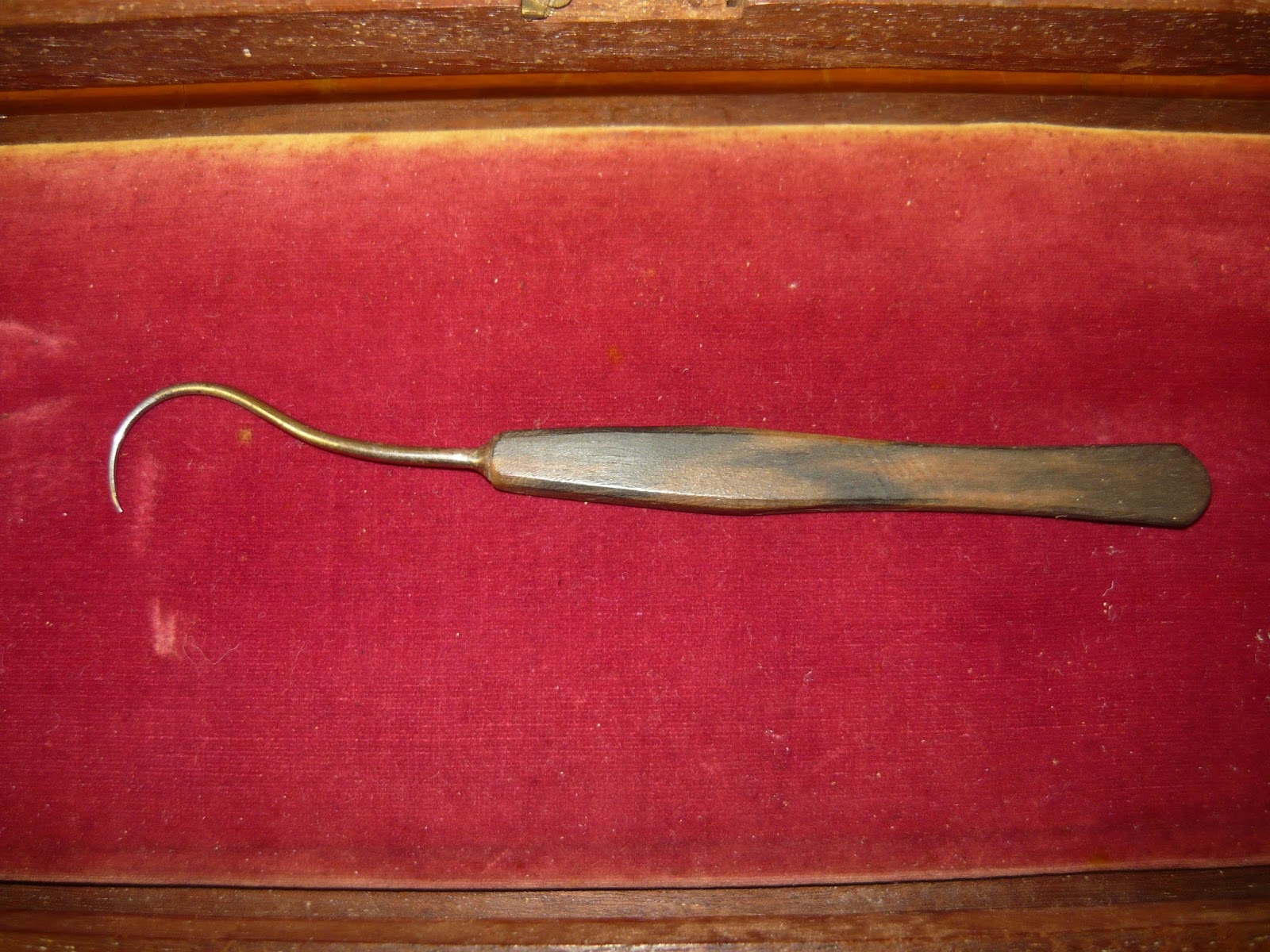

So, next time you see volunteers fund raising for hospitals, remember this equipment.  Thank goodness amputations are not as common today, but if they are necessary, these tools stay in the museums and out of the operating rooms.  


Sunday, 30 October 2016

Dead Man's Penny


It’s called the Dead Man’s Penny.  It’s a small bronze plaque that was personalized with the name of any fallen soldier in the service of the British Empire during World War 1.  The pennies are made of bronze and measure about 12cm in diameter – you can see how large it is in the palm of my hand.  It’s quite heavy, probably weighing about 1lb. 
 
 
The penny was sent to their next-of-kin in a package that included a cardboard envelope with a parchment scroll and letter from King George V. 


We have two in our museum, given in recognition of service by Lionel Wellington Nutter and Percy Leonard Robertson, both local Kings Co. men who died in World War 1.  The inscribed lettering is raised and the names are in a rectangular box.


“He died for freedom and honour” is inscribed in raised lettering as well. The front of the penny also features a raised image of Britannia, a lion, and 2 dolphins. Britannia is holding a laurel wreath and a trident.  The dolphins symbolized Britain’s sea power.  The back is blank; no images or inscriptions.
If you look closely at the bottom, you can see a smaller lion underneath the bigger one and it’s attacking the German eagle.  
 
We have some information on Lionel, but not as much on Percy.  Lionel Wellington Nutter of Kars was born on April 30th, 1895. In March of 1915 Lionel enlisted and served with the 5th Canadian Mounted Rifles. The 5th Battalion Canadian Mounted Rifles was formed in 1915 in Quebec. Later in 1915 the Battalion went overseas where they became a part of the 3rd Canadian Division, 8th Canadian Infantry Brigade. Between 1916 and 1918 the Battalion fought in France and Flanders. On March 25th, 1916, after just one year of being part of the Mounted Rifles, Lionel Nutter was killed. 
No rank was included in the penny’s inscription because, regardless of rank, the sacrifice was the same.  Over 1.3 million of them were sent out.
For more information, check out this link:  http://www.greatwar.co.uk/memorials/memorial-plaque.htm