Thursday, 6 October 2016

Little Toy - Work of Art

Every parent knows how hard it can be to get their kids out of bed.  Mozart’s father Leopold came up with an ingenius idea.  When the young Mozart refused to get out of bed, Leopold would go to the keyboard, start playing a scale, then never play the last note.  

Hum the scale to yourself – do re mi fa so la ti …….Do it a few times.  It will drive you crazy!  Imagine what it did to a musical genius like Mozart.  He got out of bed, came to the keyboard, and just banged on that last note!

Our little toy piano is only 5.5” tall, 7.5” long, and is made of wood and covered with stain.  It only has 6 keys:  C D E F G A.  No B or second C to make a full octave. I wonder what Mozart would have thought of that!  When the keys are depressed, a flat metal piece is moved to make the sound.  The pieces of this little piano are put together with tiny nails and glue.  The sound is surprisingly good; not tinny sounding at all.


In this picture below, you can see Symphony Tuned International Pitch C D E F G A painted in gilt on the piano.  Some of these little pianos were elaborately decorated and made interesting conversation pieces in homes. 


Toy pianos first made their appearance in Germany in the mid 19th century.  One that has endured until this day is the Schoenhut Piano Company founded by Albert Schoenhut from Germany.  He was the first to make these little pianos with individual keys connected to hammers that struck a glass sounding bar.  He eventually made the sounding bars out of metal, which is what the sounding bar in this little piano is made from.  In fact, the Schoenhut Piano Company which Albert founded, continues to make toy pianos to this day.  They still offer models based on designs from the 19th and early 20th centuries as well as offering new models.  Did you ever have a musical instrument as a toy?


Wednesday, 28 September 2016

Forget Me Not

This post is going to take us a little bit away from our normal description of artifacts and talk about something else - dungeons!  Usually when we think of dungeons we think of some dark, sinister place underground far beneath a castle.  But did you know that dungeons also existed in many early jails?  Our own Kings Co. Jail at the Kings Co. Museum had a dungeon!

The picture you see below is the hatch in the floor where prisoners were put when they were being a little too much trouble.  It is just a dark hole - not even room to stand, no light, no fresh air, a prisoner could barely turn around.  Most visitors to the jail don't even notice the hatch until you point it out to them.  The thought of putting a living person in there is, well, very creepy.  The purpose was to inflict maximum psychological damage on a prisoner.  Fortunately this type of punishment was eventually outlawed and remains part of our hidden histories.


Sunday, 18 September 2016

The Ice In My House

Can you image life without a refrigerator and freezer? What would we do without our Costco size rack of ribs? Well, since the refrigerator didn’t come around until the 1930s, what did people do?  Some relief came in the mid 1800s when a little invention called the icebox made its appearance. 

Iceboxes had hollow walls lined with zinc or tin.  Just as some houses used to be insulated with seawood, so did these iceboxes.  It could also be insulated with sawdust, cork, or straw.  A large block of ice was placed in a tray located in the top compartment of the icebox.  Since cool air descends, the cold air from the ice would glide down the sides of the ice box to keep veggies, fruit, meat, and milk cool on the hot summer days.  Ice was cut from rivers and stored in ice houses and the Ice Man would make door-to-door deliveries of blocks of ice.
 
The icebox was a great invention and it revolutionized the way we now store food.   In fact, some researchers believe it had a direct contribution to lower infant mortality rates during the summer months.  Some ice boxes were quite fancy and made an attractive addition to the family’s furniture.
 
Now you know why some people today still call the fridge the “ice box.”  If you remember the ice box, or remember hearing stories about them, we’d love to have you comment on this piece!

Wednesday, 7 September 2016

Plugging Away

Plug tobacco is a kind of chewing tobacco, something that was very popular in the 19th and early 20th centuries.  The handle on the one in this picture is almost 15" (38cm) long with an almost 4.5" (11cm) blade.  It's fairly heavy.


General stores had tobacco cutters so they could easily cut pieces of the bulk form of the pressed tobacco leaves for customers.  This one has a raised imprint on it that says "Enterprise M.F.G. Co. Philadelphia" as well as "Pat. July 25, 1871, Jan. 20, 1885."  Chewing tobacco was so popular that in 1938, RJ Reynolds, manufacturer of the popular Camel cigarette, had 12 brands of smoking tobacco and 84 brands of chewing tobacco.


In fact, it was so popular that "spittoons" were placed in public areas so tobacco chewers had someplace to spit.  Even some church pews were fitted with spittoons!  I guess the parish didn't like having all that spit on their floors.  But, smoke or spit - both seem like good habits not to develop! 


Friday, 2 September 2016

To Lunch or Not To Lunch

Summer’s almost over and school is starting for another year!  One of the hardest parts of getting back into the school routine is trying to figure out what to have for lunch each day.  Today there are lots of choices – schools have hot lunch programs, cafeterias, some are located in areas where students can go buy their lunch at a restaurant, and of course, you can always bring your own.

That’s what made me marvel at the little lunch pail currently on display in our jail.  It’s really small, measuring just 7.8cm (3”) high and 15.5cm (6”) long.  In fact, in the picture below you can see a ball point pen at the bottom of it.  That gives you an idea of just how small this lunch pail is. 

This metal pail is from around the 1880s and belonged to a student called Evelyn.  Lunch was usually home made bread with home-made butter, or home-made jelly or jam.  It was a real treat if students had peanut butter!  It wasn’t often students had meat in their sandwiches; many parents could not afford to buy lunch meats like we eat today.  Some memories of school day lunches include fried-egg sandwiches, mustard sandwiches, mashed potato sandwiches, and lettuce sandwiches.

Lunch pails have evolved to lunchboxes over the years with many different designs and colours.  As a kid, we weren’t allowed to have a new lunchbox every year so I can remember being very excited when the old one wore out and I was allowed to choose a new one!  My favourite had horses – kind of like the one below.


I wonder what today’s students would think if they could only eat what could fit inside this little pail? What was your favourite lunchbox?

Monday, 29 August 2016

Physics on the Farm


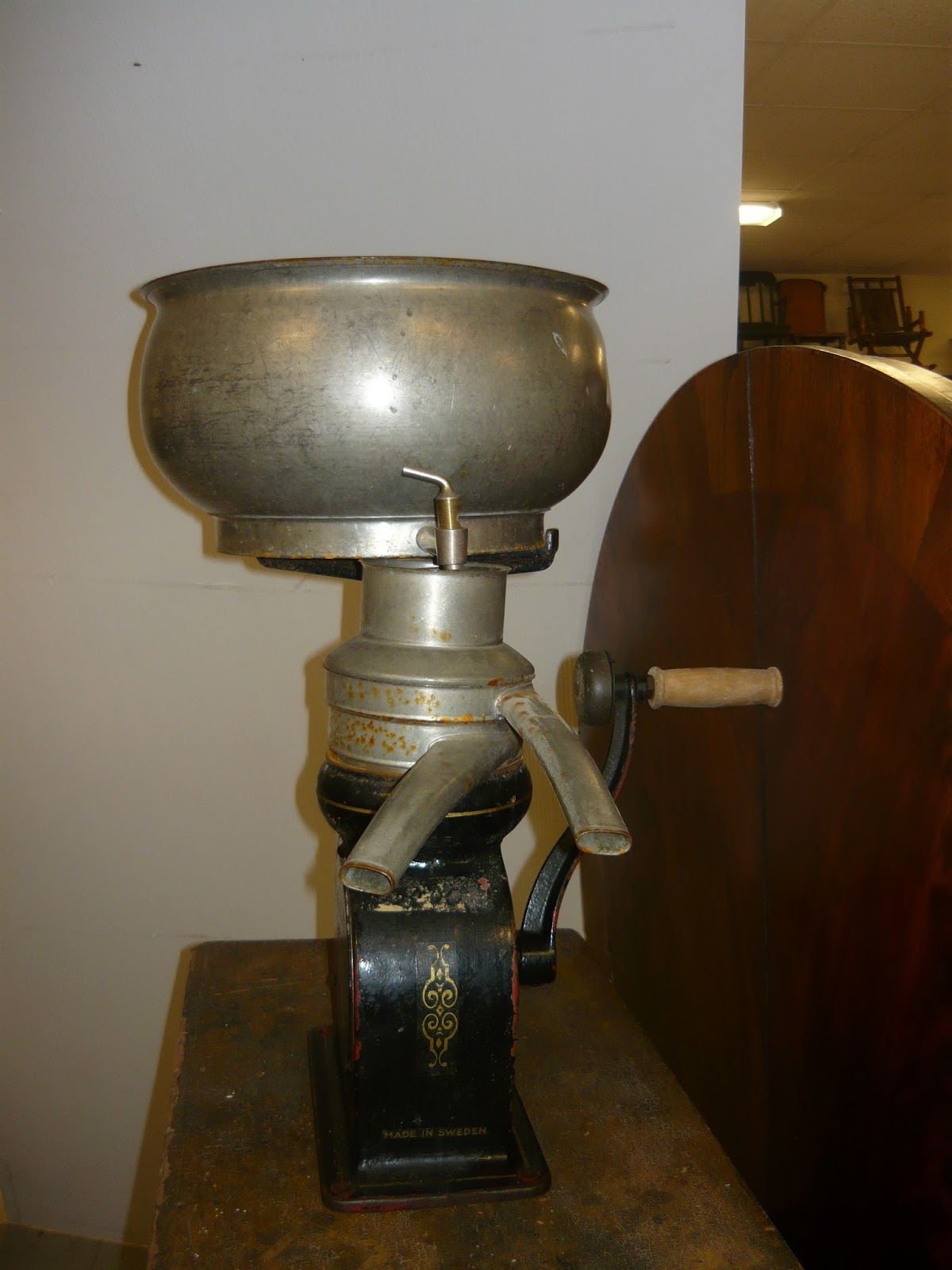
Possibly one of the most interesting tools on a farm was the cream separator.  Milk from cows was poured into the cream separator which seemed to magically separate the milk from the cream instantly.  When you look at it you wonder how can it just separate the liquid?  Here’s how:  using centrifugal force.  Who says you don’t need to know something about physics working on a farm.
Raw milk has a mix of big and small butterfat particles.  They’re held in a kind of suspension because they weigh more than other parts of the whole milk, kind of like mixing oil with water.  So, some lucky person got to stand by the cream separator and turn the handle on the side which caused the separator bowl to spin around really, really fast.  This forced the heavier milk to be pulled towards the walls of the separator while the lighter cream would collect in the middle.  Now the milk and cream could flow out of separate spouts into collection buckets.  This was way more efficient, faster, not to mention safer than having raw milk sit in a pan until the cream naturally rose to the top of the liquid.
The one in the pictures from our collection is a Vega R6 model made in Sweden.  As you can see in the picture below, the handle has “65 per min” on it. 


Cream separators are still used today, in fact, you can buy electric table top models for your own home.  Some old technologies really do stand the test of time. 
If you want to see a similar model in action, check out the YouTube video below.   No wonder people in by-gone years were more fit than we are today! 
 

Wednesday, 24 August 2016

The Moose Didn't Get Loose


Dating from the early 1820s, this trunk has a special feature that is unlike many other trunks; it is covered in moose hide. The label on the inside cover reads: "Pound and Tasker, Trunk, Chest, Box and Packing Case Manufacturers, No. 81 Leadenhill Street, London. Funerals performed".
 
 
The company that began as Pound & Tasker manufactured trunks and packing cases and was originally started by Henry Pound, John’s father, who established the company in 1823 with his partner Mr. Tasker.  It wasn’t until 1857 when Mr. Tasker died that John joined the business with his father and the name was changed to Henry Pound & Son.


John took over following his father’s death and the business soon became known as the popular John Pound & Co continuing to manufacture luggage and luxury dressing cases. The business did extremely well under John’s supervision and it soon became one of the largest of its kind in England. By 1871 John Pound & Co. boasted three factories, eight distributing warehouses, and five shops in central London. John Lulham and Percy Albert, John Pound’s sons, eventually took over the business when John became too busy with his role as Lord Mayor of London in the early 1900s.


The label in the trunk still has the company name, Pound and Tasker. Assuming they changed the labels when the company name changed it is probable that this trunk was manufactured at the beginning of the company’s time when it was under the control of Henry Pound and Mr. Tasker. The old fashioned trunk is made of wood with iron handles on both sides and dotted newspaper lining the inside. The front has a latch and lock, making it possible to secure one’s belongings. Much of the moose fur has worn off along the sides and back of the trunk, but because it seems to sit under a lot of the leather detailing, it is likely that the trunk was made this way.


So, unfortunately for this moose, it didn’t get loose but rather became a unique trunk! There are many trunks of this size in our collection, but none of the others would have made a fashion statement quite like this one.