Saturday, 5 October 2019

Hidden Histories Aren't Just Artifacts

Hidden Histories Aren't Just Artifacts

BEACONS OF LIGHT TRIBUTE TO BRITISH HOME CHILDREN
This year marks 150 years since the first Home Children arrived in Canada. The Town of Hampton  participated in the Beacons of Light tribute honouring the Home Children. On September 28th the Town Hall (still referred to as the Courthouse by many of us) was illuminated in red, white and blue.
From the late 1860s right up to 1948, 118,000 children of all ages were emigrated right across Canada to be used as indentured farm workers and domestics. While some were virtually adopted by the families they lived with, many were very poorly treated.
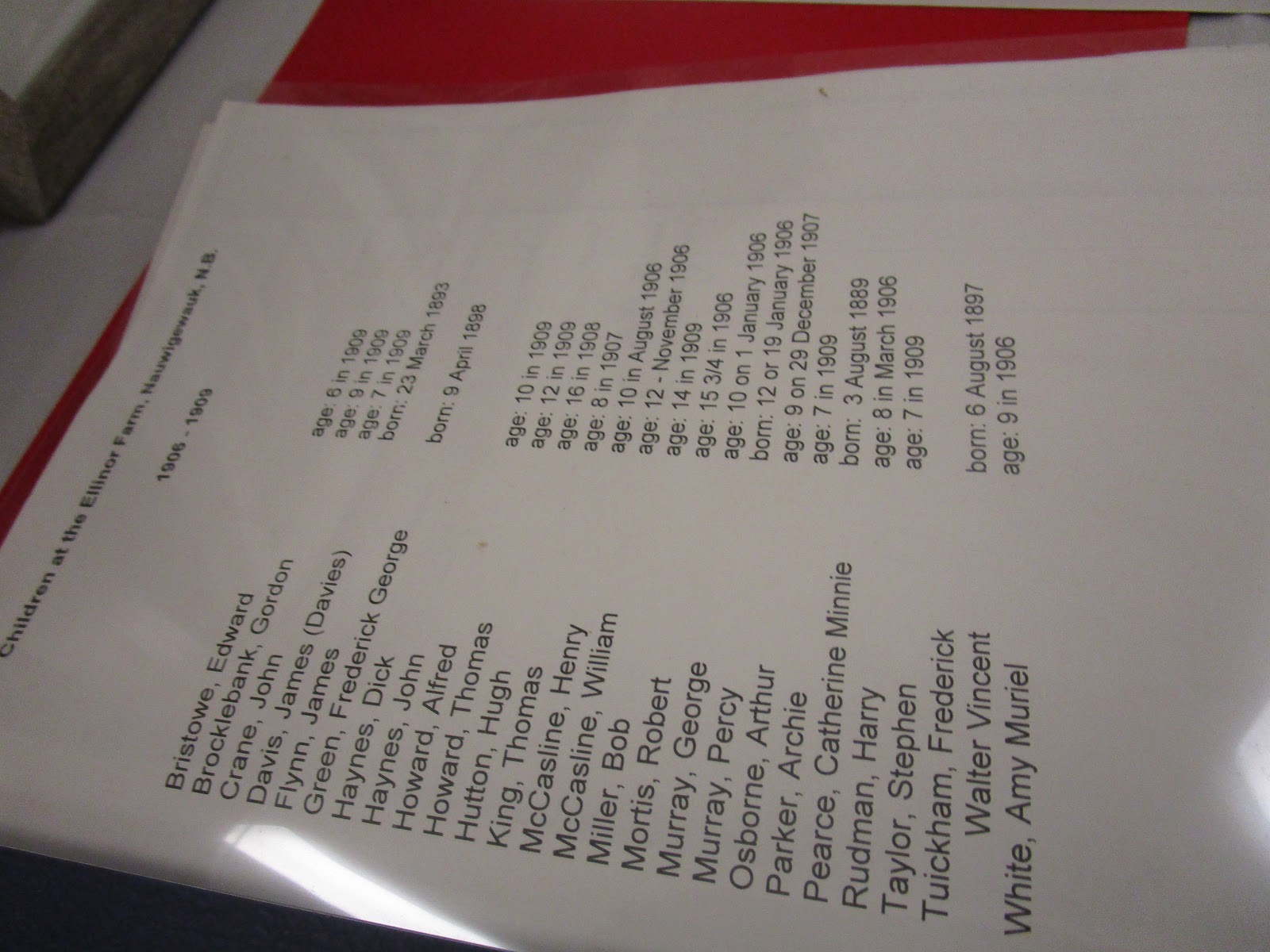
Kings County had the Ellinor Home Farm in Nauwigewauk, which operated as part of this program for several years during the early 20th century. The house is still standing today, although it is no longer operated as a farm.


The Kings County Museum has created a mini-display that will remain up during the winter, sharing some of our materials from the Ellinor Home as well as information on the Middlemore children who also came this area.
We are open Thursdays and Saturdays, 1:00 til 4:00 pm all winter, so you can drop by and explore Kings County history.
More information on the British Home Children is available at: https://www.britishhomechildren.com/


Wednesday, 2 October 2019

What is Museum Anyway?

WHAT IS A MUSEUM ANYWAY?
I was reading an interesting article this morning attempting to define what exactly IS a museum in today's world? There were many attempts to define exactly what makes a museum a unique experience. After all, as the author said, "To non-museum goers, the line between museum and not-museum is blurry. Museums are quality learning spaces, but so are libraries. Museums are experiences, but so is Disney. Museums house things, but so do libraries. Museums are adjacent and overlap so many other things."
She concludes: "We aren’t just buildings with collections. We are the places people go to learn. We are the people who collect for the future. We are conveners of communities. We are the real in a world full of fake. We are the best of society and the worst—all there to remind people about both. We are humanity on display. We are nature in its most wonderous. We are what society needs today, tomorrow, and hopefully forever."
The Kings County Museum is glad you are all part of our community as we attempt to live up to such lofty goals in our little corner of the world. Thank you for your support.


Wednesday, 24 April 2019

Check out our new video of the Old Kings County Gaol (Jail), built in 1840 in the nearby community of Kingston, New Brunswick and relocated to Hampton when the shiretown moved here in 1870.

Monday, 11 February 2019

Heritage Week 2019

Heritage Week 2019
Each year at this time Canadians are invited to celebrate our heritage. This year, during the period February 11 - 18, the theme is Our Living History: Exploring our Cultural Heritage.
Museums such as the Kings County Museum have a critical part to play in preserving and celebrating our heritage, both physical and cultural. Museums provide a tangible link to our rich cultural history, and without them future generations will not have the opportunity to truly understand what our ancestors have achieved.
While much can be learned by reading about times past and looking at old photos, nothing compares to seeing it with your own eyes. When young people visit our museum and see how a roller organ (what I call "the ipod of a hundred years ago") works, and may even get to turn the crank and play the music themselves; when they see how underwear was originally made of two pieces that were fastened at the waist, and only in later years sewn into one garment and they suddenly understand why it is a PAIR of underwear, these experiences will stay with them far longer than reading an explanation in a book or on a computer screen.
We are open Thursday and Saturday afternoons all winter. Come by for a visit . . . and bring the kids.

Sunday, 6 January 2019

Postcards from Home

Postcards from Home

The Kings County Museum has a wide variety of local and international postcards in our collection. This one is a photo of Church Avenue, Sussex that was mailed in 1908 to Miss Nellie MacFarlane of Norton by L.M.S.
Postcards were hugely popular during the early 20th century, and many families had albums of them holding greetings from near and far. Friends and relatives used them to keep in touch at a distance. According topostcardy.com, official United States Post Office figures for the year ending June 30, 1908 cited 667,777,798 postcards mailed in the United States. By 1913 the total in the United States was over 968,000,000, after which date the craze was reportedly declining.


Sunday, 3 June 2018

ANNIDALE The Story of an Abandoned NB Community

ANNIDALE The Story of an Abandoned NB Community

We have recently received several copies of a newly published book on the community of Annidale from the author, John R Elliott.

In 1891 Annidale (located some 13 miles from Sussex) was described as a thriving community with a train station, a post office, saw and grist mills, a blacksmith and a commodious public hall. Sixty years later the community had ceased to exist. The book traces the settlement from the early 19th century through to its final years in the mid-twentieth century, and includes brief genealogies of the 40+ families who once lived there.

Annidale - From Wilderness to Wilderness is now available for purchase at the Museum.


Tuesday, 29 May 2018

LAND GRANT MAPS

LAND GRANT MAPS
One of the projects for this past winter involved finding a better way to store and utilize our New Brunswick Land Grant Maps. We have now organized the local ones into an art rack (which in this case would be better labeled as a map rack) which displays the local land grant maps in a protected and easily accessible manner. If you are researching your family tree it is great to be able place the grants geographically and see who your ancestors' neighbours would have been. We currently have the map rack in the main exhibit room, just in front of the 1862 Walling Map which shows the landowners from that year. Come see!


Sunday, 13 May 2018

Dog Fur Coats

Dog Fur Coats
During our exploration and reorganization of the textiles in our collection we came across several dog fur coats. During the early 20th century it was not uncommon for the less wealthy who desired a fur coat to wear coats made of dog fur. We have several in our collection in various sizes from child to man. Pictured below are two ladies coats.
Although fur was worn as clothing in early history, as early as the 11th century, fur was worn as a symbol of wealth and social status rather than just out of the need for warmth. European royalty regularly wore fur coats, fur capes, and fur accessories made from mink, sable, and chinchilla fur. By the 1300s, laws were introduced that regulated which social classes were allowed to wear which types of furs.
The wearing of fur became more widespread during the Victorian era. The fur coats that were worn by Victorian men typically were lined with fur on the inside and crafted of other materials on the outside. Women’s fur coats were generally lined with fur at the collar, wrists, and hem.


Sunday, 29 April 2018

FEATHER IN YOUR CAP?

FEATHER IN YOUR CAP?
Feathers have been used as ornament for centuries. Marie Antoinette (last Queen of France) is quoted as saying, "It is true I am rather taken up with dress; but as to feathers, every one wears them, and it would seem extraordinary if I did not." I am sure she would loved the feather capelet and epaulets that we have discovered in our textile collection. Made of peacock feathers, it was brought to Hatfield Point on a sailing vessel by Captain Solomon Davis, which would make the latter part of the 19th century. We don't know if his wife ever wore the caplet, but if she did she must have felt very elegant in it. It will be part of summer display this year.


Sunday, 22 April 2018

The First History of New Brunswick

The First History of New Brunswick

This book by Peter Fisher was first published in 1825 under the title Sketches of New Brunswick. Below is an excerpt from the section on Kings County. I was surprised at the population (2011 population 69,665):

"It contains seven thousand nine hundred and thirty inhabitants.

It comprehends the Long Reach, the Kennebeckasis (sic) and Belisle (sic), and is divided into the following parishes - Westfield, Greenwich, Kingston, Springfield, Norton, Sussex and Hampton. Kingston has a Township regularly laid out, which bears the name of the Parish. It has a neat Church, with a resident Minister, and a number of neat buildings, which make a fine appearance. The Court-House, however is a considerable distance from the Town. The settlers in most parts of this Parish have the appearance of comfort and affluence, although the land is inferior in fertility to most of the other Parishes.

. . . There are two quarries of excellent Plaster of Paris on the river Kennebeckasis. There is likewise a salt spring in this part of the country, from which small quantities of salt have been made by the Indians and the Inhabitants settled near the place, which has proved of an excellent quality for the table, and there can be no doubt of its possessing valuable medicinal qualities; but no attention has yet been paid to analyse it. Great quantities of sugar are extracted from the sugar maple in this county, upwards of ten thousand pounds have been made in a year, of that valuable article in the Parish."

Monday, 9 April 2018

1923 Spring Flood

1923 Spring Flood in Hampton
As each Spring arrives many of us are looking at the rivers and creeks around us and wondering what the water levels will be this year. In a newspaper account from 1923 it was reported: "This last week is one that will be remembered for many years to come on account of the severe freshet that has covered the bridges and railway tracks, surrounding and entered a number of dwellings at the village and station.This is the first time since 1887 that boats had to be used to get from the village to the station. The bridge over the creek is completely covered in water and partly washed away, and the road for several rods is covered by water [Note: a rod is approximately 16.5 feet]. The houses along Langstroth Terrace have to be reached by boats and several houses nearer the river bank are completely surrounded, one family having to live upstairs as the water had entered the downstairs. Several barns are washed away. The amount of damage done is great."
The 1923 flooding along the Saint John River and its tributaries resulted in estimated damages totaling $532 million in today's dollars.New Brunswick's River Watch Program for the 2018 freshet season started on March 12, 2018 and as of yesterday there are no flood risks reported.If you want the latest information on flooding this spring you can go the government website or access the mobile app at https://www.watercanada.net/new-brunswick-flood-forecast-d…/

Saturday, 24 March 2018

Letter Writing

Letter Writing
Many of us "older folk" lament that cursive writing is becoming a lost art. There was a time when elegant handwriting was a status symbol and there were schools in penmanship. While penmanship is still taught in Europe, North American schools have largely eliminated it from the curriculum. The invention of the typewriter in 1867 began the movement away from penmanship, and the growing usage of electronic devices has largely eliminated the related skill of letter writing.
Schools in early Kings County spent many hours teaching first reading, then cursive writing, and then instructing in the proper form for letter writing, as this was the principle way of communicating. Young men away at war wrote letters home and eagerly awaited letters from parents and wives to get the news from home. Young women who married and moved with their husbands to new communities wrote letters home. Siblings could go their whole adult lives not seeing each other, but remaining in touch through letters.
If you want your children to experience the joy of writing a letter, you may be interested in an up-coming event at the Saint John Public Library in which your child can compose and type a letter on an old typewriter, perhaps similar to the one pictured below. This typewriter from our museum collection is a Woodstock No. 5, manufactured in Woodstock, Illinois between 1912 and 1922.


Monday, 19 March 2018

HAMPTON CONSOLIDATED SCHOOL

We have a number of photos of Hampton Consolidated School in our photo collection, including of the fire that led to its demise. Hampton Consolidated School opened in the fall of 1907 on the site of the current Hampton Middle School. As it served the students of both Hampton Village and Hampton Station, it was constructed midway between the two communities. By the time the building burned in March of 1981 it had become Hampton Junior High School, with the high school students being bused to the Kennebecasis Valley High School. It was a Thursday morning on March 12th that the 452 students were safely evacuated and watched, with much of the community, as their school burned. The students had only a few days off, however, as portable classrooms were quickly set up and work commenced on the construction of the new school and amazingly several classrooms were ready for use by September of that year and the rest as the term progressed.


Saturday, 10 March 2018

EXPLORE YOUR IRISH ROOTS
The Kings County Museum has a large collection of local family histories in our Research Room and we will be open on St Patrick's Day, March 17, from 1:00pm until 4:00pm.
Come explore your Irish roots. Locate your family home on our Irish Family Homes Map. Get hints on research with our books Handbook on Irish Genealogy by Heraldic Artists Ltd, Tracing Your Irish Roots by Christine Kinealy or Immigrants from Ireland to Kings County Prior to 1840. For those wearing their green, the $10 research fee will be waived.
And remember . . . "If you're lucky enough to be Irish, you're lucky enough".


Sunday, 4 March 2018

Treasure from the Storeroom:

Treasure from the Storeroom:

One of my favourite items unearthed from the storeroom during the recent clean-out was this beautiful ladies dress from the mid 1800's. It is a fairly recent acquisition and has not yet been displayed, but I anticipate it being a hit for our exhibit this summer. It belonged to Mrs Julia Nembhard Helen (Kortright) Neales, wife of Rev Dr James Neales of Gagetowm She was born in 1831, married in 1849, moved to Gagetown in 1859, died in 1885. It is handstitched with an elegant Scallop pattern at the neck and the sleeves, fully lined, and in excellent condition. It has detachable "Modesty Sleeves" and a 22 inch waist!


Sunday, 4 February 2018

Heritage Homes

February 12-19 2018 is Heritage Week in New Brunswick.

Celebrating our heritage is not just about musty old clothes in your grandmother's attic (although attics are amazing places to explore). Heritage includes the buildings that house those attics! Kings County is fortunate to have many heritage homes, but regrettably not all have survived. Ryan's Castle in Lakeside (Hampton) is one such. On a property of approximately 10 acres overlooking Darling's Lake (on land now owned by the Downey family), the showcase home was purchased in 1895 by Dr John J Ryan. Dr Ryan, the son of James Ryan of Millstream, became a celebrated dentist in Paris. He purchased the home as a summer home and is said to have spent $70,000 on renovations to the house and grounds, including a model barn constructed by George Langstroth. The lovely home deteriorated after the death of Mrs Ryan in 1927 and after a number of years being vacant and vandalized it burned in 1963.


Sunday, 28 January 2018

I Do . . .

I Do . . .
With Valentine's Day approaching this is good time to share a few of the wedding dresses we have in our textile collection. Traditionally brides did not have a "wedding" dress, but rather wore their "best" dress for the marriage, or if they had a new dress for the wedding it was often black or blue and intended to become her best dress. White did not become popular for wedding dresses until after the mid-19th century when Queen Victoria chose to wear white for her marriage, after which the wealthier families began wearing white dresses made specifically for the marriage.
We have a number of gowns in our collection, a few of which are:
1. A dress worn by Mary Steeves for her 1880's marriage to Wilford Burwell Jonah.
2. A 1908 dress made by Ethel McLeod Good for her wedding to Oscar Frederick Deakin.
3. A dress worn by Mary Shanklin for her marriage to Rev. Sedgewick A Bayley, about 1907.
4. A gown from the wedding of Grace Winnifred MacKay in 1909
5. A dress worn by Annie Frost Wetmore for her 1913 wedding to William Stirling Parlee.


Sunday, 21 January 2018

SHERIFF WALTER BATES

We received some archival documents back from the New Brunswick Museum recently and they needed to be processed to be returned to our archives. Among them were these 200 year old documents, some in Sheriff Bates own handwriting, regarding the operation of the County Gaol. There are expenses claimed for handcuffs and chains and clothing for the prisoners, and an expense of moving a prisoner "out of the county" at a cost of 6 pounds. At this time the gaol would have been located in Kingston, which was then the county seat. It is not the same building as currently stands in Hampton, as that is the "new" gaol, built in 1840 and subsequently dismantled and moved to Hampton when the county seat was moved in 1870.
Sheriff Bates was a Loyalist who came to New Brunswick from Connecticut and spent many years as the"High Sheriff of the County of Kings". He is likely best known for his book The Mysterious Stranger, recounting the story of Henry More Smith and his time in the County Gaol. Henry More Smith was "a confidence man, master puppeteer, hypnotist, seer, liar, and above all else a superlative escape artist who lived for a while in New Brunswick, Canada. Chains, handcuffs, shackles, even made-to-fit iron collars could not hold him." (https://en.wikipedia.org/wiki/Henry_More_Smith).


Saturday, 23 December 2017

A GIFT TO GRACE YOUR TABLE

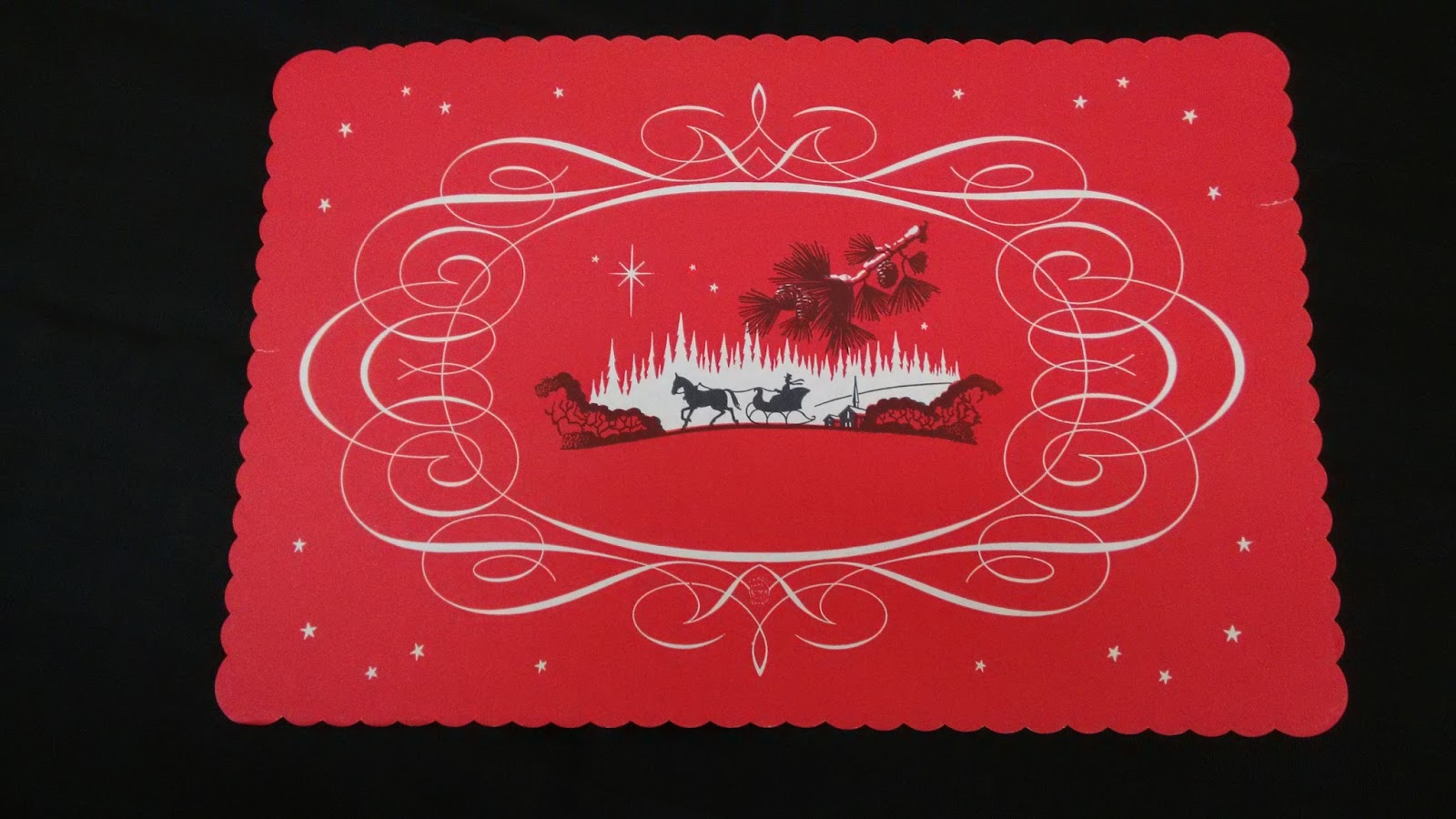
So says the large envelope dated December 1955 and addressed to Mr Harold Morgan of Hampton Village (no street address required) from Kaye's Auto and Electric. Inside is a large "Season's Greetings" Christmas card from Kaye's Auto-Electric, Dealer for Mercury, Meteor, Lincoln, Frontenac, and English Built Ford Products. Lift that and you find a set of paper Christmas placements, 4 each of 4 .different designs. I found it interesting that the message is "season's Greetings" not "Merry Christmas". A man ahead of his time?
According to David Keirstead's "Reflections, The Story of Hampton", the Kaye's garage was built by Whit Scovil, opening in the spring of 1948. For a few months it was run by Harold Piers, but was soon taken over by Eldon Kaye in November of that same year. I don't know when it closed, perhaps one of our readers can enlighten us, but it was till in operation when David's book was written in 1982. It was located on the present site of Spuds N Things.


Sunday, 17 December 2017

CHRISTMAS 1897
The Flewwelling Mill complex was the economic backbone of Hampton during the late 19th century. First established in 1862 by brothers Gilford and George Flewwelling, together with partners Gilbert White and Samuel White, by 1893 it employed 150. Gilbert Flewwelling died in 1897 at the age of 62. That December his "fellow workmen" were given a souvenir card with his portrait in remembrance of him.
Interestingly, the first Christmas Card was the brain-child of a British civil servant, Sir Henry Cole, who had helped set up the Penny Post three years earlier and was looking for ways to have more people use the service.